
Tachiyomi APK Download: Latest Version Free Manga Reader Guide (2026)
Tachiyomi is a free, open-source manga reader app for Android that lets you read manga, manhwa, manhua, webtoons, and light novels from hundreds of online sources — all inside one clean, ad-free library. If you’re here to download the Tachiyomi APK, install the latest version, set up extensions, and start reading in the next five minutes, this guide covers every step, setting, reading mode, and troubleshooting fix you’ll ever need, in one place.
Below you’ll find the direct download instructions, a full breakdown of what’s new in the latest Tachiyomi APK, a complete installation walkthrough, an extensions and sources guide, every reading mode explained, backup and restore instructions, PC and iOS workarounds, a detailed Tachiyomi vs modded Tachiyomi APK comparison, safety and legality information, and a 30-question FAQ section that answers virtually everything people search for about this app. No fluff, no filler — just a complete, accurate, and up-to-date resource.

Quick Overview: What You’re Downloading
| Detail | Information |
|---|---|
| App Name | Tachiyomi (manga/manhwa/manhua reader) |
| Category | Manga, Anime, Comics, Light Novels |
| Latest Version | Tachiyomi APK v0.15.4 (regularly updated) |
| File Size | Approx. 20–22 MB |
| Platform | Android 5.0 (Lollipop) and above |
| License | Free, Open Source (GPL-3.0) |
| Ads | None in the official build |
| Content Source | Third-party extensions (app hosts no content itself) |
| PC Support | Yes, via Android emulator |
| iOS Support | No official app; alternatives available |
| Recommended For | Users aged 16+ due to extension-dependent mature content |
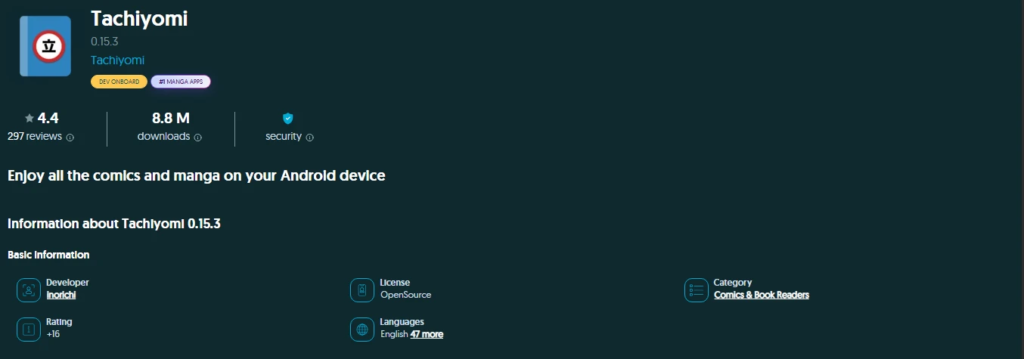
What Is Tachiyomi? A Complete Introduction

Tachiyomi is a manga reader application, not a manga hosting service. This distinction matters more than most guides explain clearly. The APK itself contains no manga, no manhwa, and no manhua — it is essentially an empty, highly customizable reading engine. All content comes from extensions (also called sources), which are small add-on packages that connect the app to different manga and comic websites across the internet.
This open-source, community-driven model is what separates Tachiyomi from closed, ad-heavy manga apps on the Google Play Store. Because the source code is public, independent developers, translators, and volunteer contributors can inspect it, fix bugs, patch security issues, and build new extensions without waiting on a single company’s release schedule. That transparency is also why the app isn’t distributed through the Play Store — Google’s policies don’t allow apps that link out to unlicensed content aggregators, even when the core app itself is legal and content-neutral.
For readers, the practical result is a single, unified library where you can organize manga, manhwa (Korean comics), manhua (Chinese comics), webtoons, and even light novels pulled from dozens of different websites, all searchable, downloadable, and readable offline from one home screen — instead of juggling ten different browser bookmarks and ten different reading experiences.
Who Tachiyomi Is Built For
Tachiyomi is designed for readers who want control: control over their library organization, their reading layout, their backup data, and their privacy. It suits people who follow long-running series across multiple sites, webtoon readers who want seamless vertical scrolling without ads breaking the panel flow, and collectors who like tracking reading progress, downloading chapters for offline commutes, and switching between light novels and manga in the same app.
Because some manga sources include mature or NSFW-adjacent titles depending on which extensions a user installs, the app is generally recommended for users aged 16 and above rather than for children, and content filtering settings are available for anyone who wants a stricter, cleaner browsing experience.
Why Tachiyomi Beats Other Manga Reader Apps

Most manga apps you’ll find on the Google Play Store fall into one of two categories: heavily monetized apps stuffed with banner ads, interstitial ads, and forced subscriptions, or apps with a limited, curated catalog that misses half the series you actually want to read. A popular example from the past, Manga Rock, offered a genuinely well-organized library and smooth reading experience for years — but that app was discontinued and is no longer available today, leaving a gap that Tachiyomi has effectively filled.
Here’s what sets Tachiyomi apart from typical manga, manhwa, and comic reader apps:
- No forced ads in the official build — your reading isn’t interrupted by pop-ups or video ads.
- Unlimited sources through extensions, instead of being locked to one publisher’s catalog.
- Offline downloading for every chapter, so you can read on flights, commutes, or anywhere without signal.
- Full customization of reading direction, page layout, themes, and library display.
- Local-first privacy — your library, history, and backups are stored on your device, not harvested for ad targeting.
- Active open-source development, meaning bugs get reported and fixed by a real community rather than a single unresponsive publisher.
- Cross-format support for manga, manhwa, manhua, and light novels in a single app, rather than needing separate apps for each format.
Tachiyomi Latest Version: What’s New
The current stable build of Tachiyomi is regularly updated to fix bugs, patch security issues, and refine the reading experience. Because Tachiyomi is open source, every new release is published transparently, and update notes are publicly documented rather than hidden behind a vague “bug fixes and improvements” changelog like many closed-source apps use.
Recent updates to the Tachiyomi APK latest version typically focus on:
- Extension compatibility fixes — keeping installed sources working as target websites change their layouts.
- Reader performance improvements — faster page loading, smoother scrolling in continuous and webtoon modes, and reduced memory usage on older devices.
- Backup and restore reliability — ensuring your library, categories, and reading history survive app reinstalls or device changes without data loss.
- UI and settings refinements — small quality-of-life changes to the Library, Browse, and Settings sections.
- Security patches — addressing vulnerabilities flagged by the open-source community, which tend to get resolved faster than in closed apps because anyone can review the code.
Because the latest Tachiyomi version is not distributed through the Google Play Store, it’s important to always download new builds from a trusted, official source rather than random third-party mirror sites, which are a common vector for repackaged, ad-injected, or malware-laced APK files.
System Requirements and Compatibility

Before downloading the Tachiyomi APK, confirm your device meets the minimum requirements:
- Operating System: Android 5.0 (Lollipop) or higher
- Storage: At least 50–100 MB free for the app itself, plus additional space for downloaded chapters (manga chapters with many high-resolution pages can range from a few MB to 100+ MB each)
- RAM: 2GB minimum recommended for smooth scrolling in continuous and webtoon reading modes
- Permissions: Storage access (for downloads and backups), and network access (for browsing extensions and loading chapters)
- Internet Connection: Required for browsing, adding manga, and downloading chapters; not required once chapters are downloaded for offline reading
Tachiyomi does not have an official iOS build and does not run natively on iPhone or iPad. It also isn’t officially supported on Windows or macOS, though it can run through an Android emulator — both of which are covered in dedicated sections further down this guide.
How to Download the Tachiyomi APK: Step-by-Step
Downloading the Tachiyomi APK is straightforward once you know which files you actually need. Follow these steps:
- Visit a trusted download source. Because Tachiyomi isn’t on the Google Play Store, always use an official or verified source rather than an unfamiliar third-party mirror.
- Choose the correct APK file for your device. Most releases offer a universal APK plus architecture-specific builds (arm64-v8a, armeabi-v7a, x86, x86_64). If you’re unsure which your phone uses, the universal APK works on virtually all modern Android devices, just at a slightly larger file size.
- Download the file. Depending on your source, this may come as a direct
.apkfile or inside a.ziparchive that needs extracting first. - Verify the file size and source before installing — a Tachiyomi APK should be roughly 20–22 MB; a file that’s dramatically smaller or larger, or bundled with unrelated installer prompts, is a red flag.
- Proceed to installation using the steps in the next section.

Always download the latest Tachiyomi version rather than an old cached file, since older builds are more likely to have broken extensions, unpatched bugs, or compatibility issues with modern Android versions. If you specifically need an older release for compatibility testing or a legacy device, a full archive of Tachiyomi old versions is available separately.
How to Install the Tachiyomi APK on Android
Because the Tachiyomi APK is installed outside the Google Play Store, Android will require you to explicitly allow installation from unknown sources. Here’s the complete installation process:
Step 1: Enable Unknown Sources

Go to Settings → Apps → Special App Access → Install Unknown Apps, select the browser or file manager you used to download the APK, and toggle Allow from this source. On older Android versions, this setting may simply be under Settings → Security → Unknown Sources.
Step 2: Locate and Open the Downloaded File
Open your file manager or notification tray, find the downloaded .apk file (or extract it first if it arrived inside a .zip archive), and tap it to begin installation.
Step 3: Grant Permissions

Tap Install, and once the process finishes, open the app and grant the storage and notification permissions it requests. These permissions are required for downloading chapters, creating backups, and displaying update notifications — the app does not request permissions unrelated to its core reading and library functions.
Step 4: Confirm the App Opens Correctly
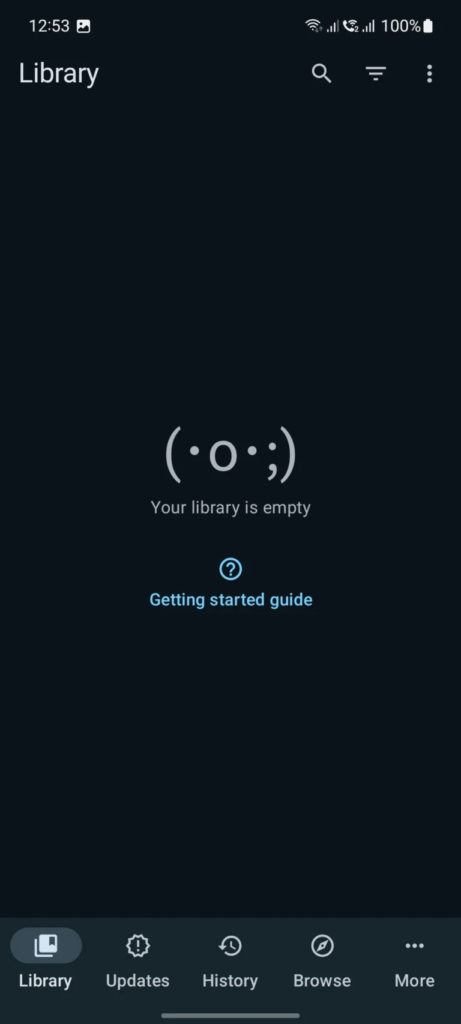
Launch Tachiyomi. On first open, your Library will be completely empty — this is expected and normal, since the app doesn’t come preloaded with any manga. The next section walks you through populating it.
How to Add Manga Using Extensions and Sources

This is the step that trips up most new users, so here’s the complete process broken down clearly.
Step 1: Open the Extensions Section
From the bottom navigation bar, tap Browse, then select the Extensions tab. This is where you install add-on packages (extensions) that connect the app to specific manga, manhwa, and manhua websites.
Step 2: Install an Extension
Browse or search the extension list, tap the one you want, and tap Install. Popular extension categories include general aggregator sources, dedicated manhwa/webtoon sources, and light-novel sources (such as those compatible with Madara-based or LNMTL-based sites).
Step 3: Browse the Source
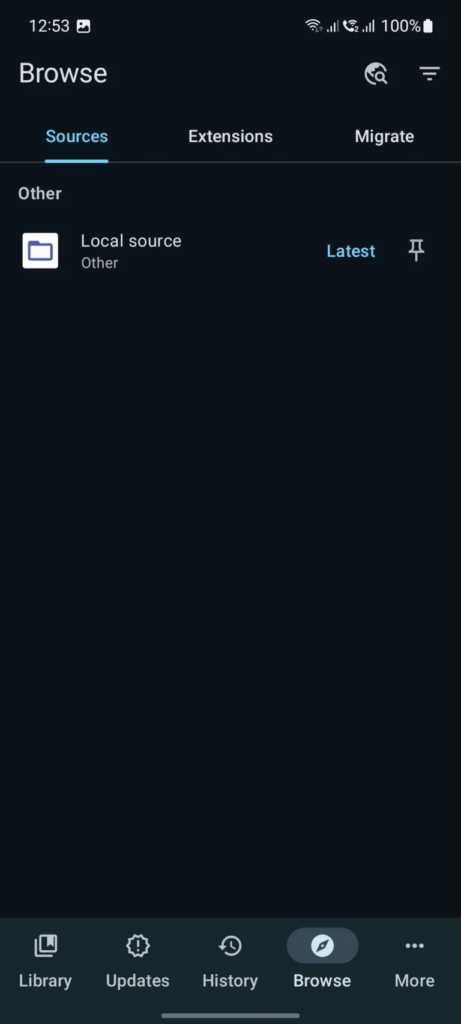
Once installed, go back to Browse → Sources, tap on your newly installed extension, and you’ll see a searchable catalog of titles from that site, complete with filters for genre, status, and popularity.
Step 4: Add Titles to Your Library
Open any series and tap Add to Library. It will now appear on your home Library screen, where you can track new chapters, read progress, and download content.
Step 5: Repeat for More Sources
Because no single extension covers every series, most users install multiple extensions to maximize catalog coverage — this is one of Tachiyomi’s biggest advantages over single-source manga apps.
For a deeper walkthrough with screenshots for each of these steps, see our full Tachiyomi extensions installation guide and the dedicated Tachiyomi extensions resource page. If an extension stops working after a site redesign, our extension update troubleshooting guide walks through the fix.
For readers who want general background on the manga medium itself — its history, art style, and the difference between manga, manhwa, and manhua — Wikipedia’s overview of manga is a solid, neutral reference point.
Downloading Manga Chapters for Offline Reading

Once a title is in your library, you can download chapters for offline access:
- Single chapter: Open the manga, long-press the chapter you want, and tap the download icon.
- Multiple chapters: Long-press one chapter to enter selection mode, then tap Select All (or manually select a range) and confirm the download.
- Entire series: Some versions allow a “download all” shortcut directly from the manga’s detail page.
- Monitoring downloads: Go to the Download Queue in Settings to pause, resume, or cancel downloads in progress, and to see estimated completion for large batches.
Downloaded chapters are stored locally, so once they’re saved, you can read them without an internet connection — ideal for flights, commutes, or areas with unreliable signal.
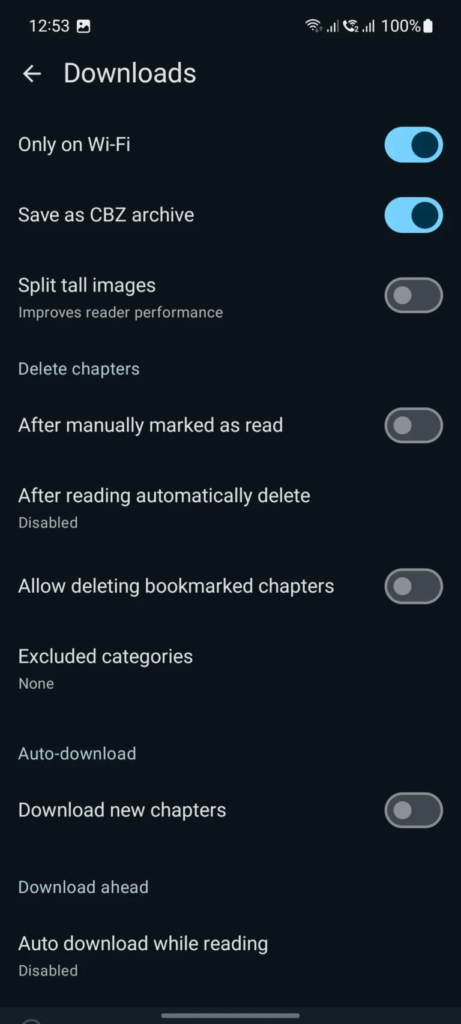
For more control, the Downloads settings screen lets you require Wi-Fi before downloading (avoiding mobile data usage), save chapters as CBZ archives for compatibility with other reader apps, split tall webtoon images for smoother performance, and automatically delete chapters once they’re marked as read — handy if you’re managing limited phone storage.
Managing Your Manga Library Effectively
The Library section is the home screen of Tachiyomi and the heart of daily use. Getting familiar with its filtering and display options makes a much bigger difference to day-to-day usability than most new users realize.
Library Filters
Three primary filters help you narrow down a large collection instantly:
- Downloaded — shows only titles with chapters saved for offline reading
- Unread — surfaces series with new, unread chapters
- Completed — isolates finished series you’ve fully read
Display Options
You can switch between List View (compact, text-focused) and Grid View (cover-art focused, visually browsable), depending on whether you prefer scanning titles quickly or browsing by cover art. Library items per row are also adjustable for both portrait and landscape orientations.
Categories
Custom categories let you organize your library the way you actually think about your reading — for example, separate lists for “Currently Reading,” “Favorites,” “On Hold,” or “Completed Webtoons.” The Categories tab itself can be shown or hidden depending on how much organization you want visible on the main screen.
Swipe to Refresh
Swiping down on the Library screen triggers a manual refresh, checking every followed source for new chapters across your entire collection in one action — far faster than checking each series individually.
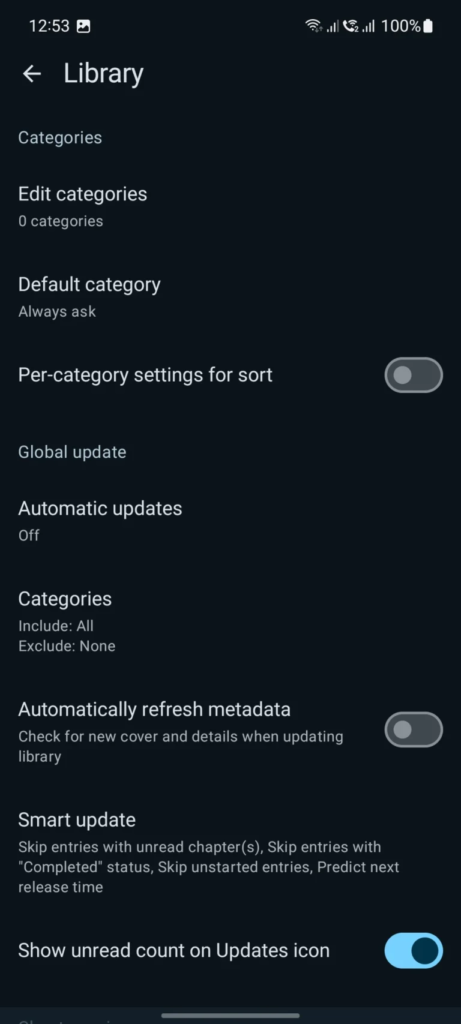
The Library settings screen goes even deeper: Smart Update can skip entries with unread chapters, skip completed series, or skip unstarted entries during a global refresh — saving time and data on large libraries — while Automatically Refresh Metadata keeps cover art and details current whenever your library updates.
Backup and Restore: Never Lose Your Library

One of Tachiyomi’s most valued features is its local backup and restore system. Because your library, reading history, categories, and download status are stored entirely on your device rather than a remote account system, creating regular backups is essential before reinstalling the app, switching phones, or clearing app data.
To create a backup, go to Settings → Backup and Restore → Create Backup. This generates a backup file containing your full library structure, which you can store locally, upload to cloud storage, or transfer to a new device. To restore, simply select Restore Backup and choose the saved file — your entire library, including categories and reading progress, returns exactly as it was.
For a complete walkthrough including automated backup scheduling and cloud storage options, see our full Tachiyomi backup guide.
Advanced Settings and Customization
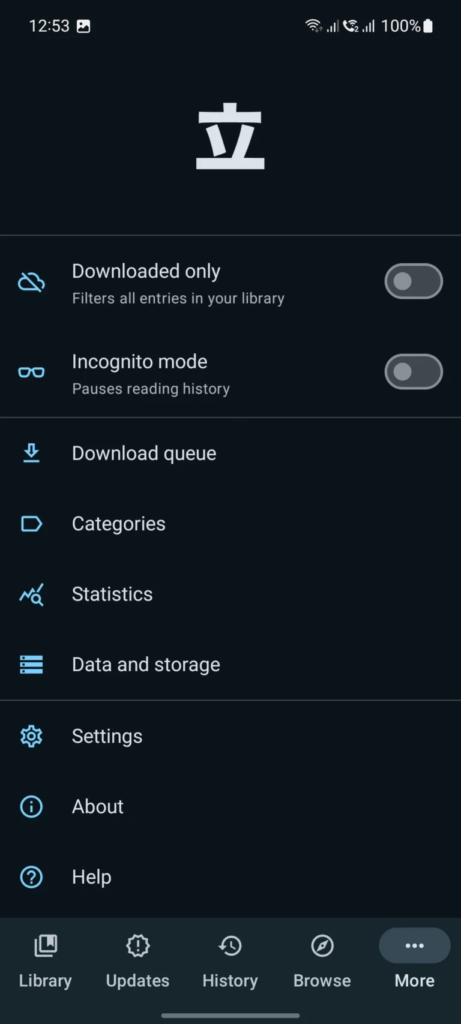
Beyond the core library and reading functions, Tachiyomi includes a deep settings menu for readers who want more control. Tapping More in the bottom navigation opens quick access to Downloaded Only, Incognito Mode, Download Queue, Categories, Statistics, Data and Storage, Settings, About, and Help — the full control center for the app.
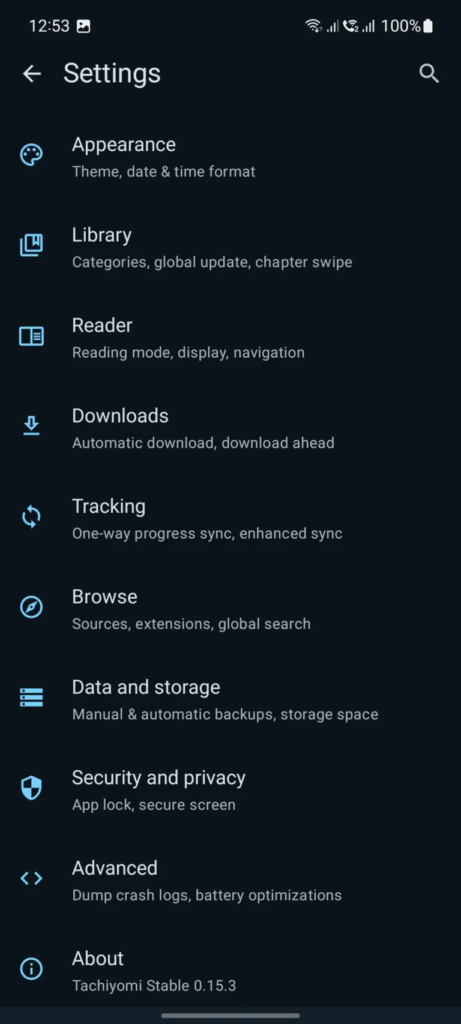
Diving into Settings reveals nine dedicated sections: Appearance, Library, Reader, Downloads, Tracking, Browse, Data and Storage, Security and Privacy, and Advanced. Here’s what matters most:
- Downloaded Only Mode — hides everything except titles with chapters already downloaded, useful for travel or limited data plans.
- Incognito Mode — temporarily pauses reading history tracking, so browsing or reading a series doesn’t affect your “recently read” or tracker progress.
- Global Search — searches across every installed extension simultaneously instead of one source at a time, dramatically speeding up the process of finding where a specific title is available.
- External Tracking — connects your reading progress to third-party tracking services so your read status stays synced across platforms.
- Content Visibility Controls — lets you mark and filter mature content, useful for keeping the browse experience appropriate to your preferences.
- Cache Management — clearing the cache periodically helps keep the app responsive, especially after long use with many active sources.
- Battery Optimization Settings — disabling aggressive battery optimization for the app can prevent background downloads and update checks from being killed by the system.
If you want an ad-free experience across every part of the app, our guide on using Tachiyomi without ads covers the relevant settings in detail.
Customizing the Look: Themes and Display
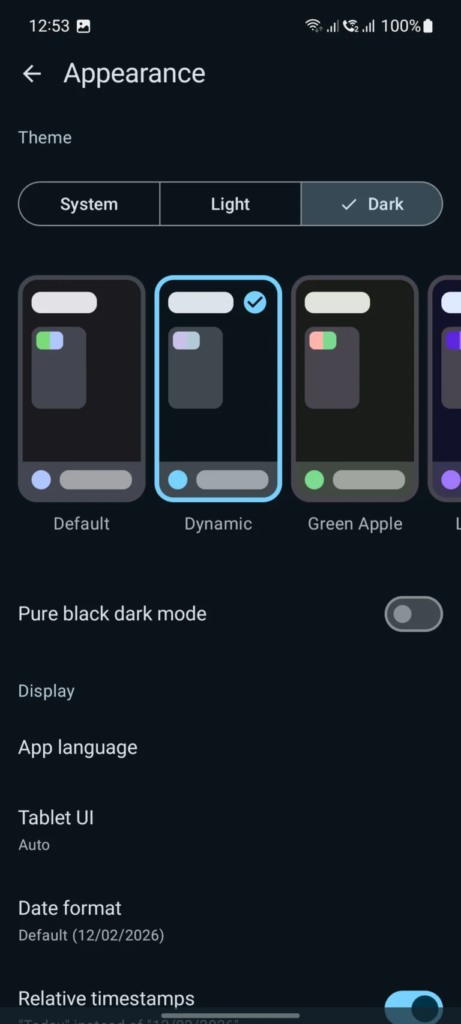
Tachiyomi includes a full theming system beyond a simple dark/light toggle. From Settings → Appearance, you can choose between System, Light, or Dark mode, then pick from several accent color themes (Default, Dynamic, Green Apple, and more), enable Pure Black Dark Mode for OLED battery savings, and adjust date format and relative timestamps. It’s one of the most-used settings screens for anyone who reads at night or wants the app to visually match their phone’s system theme.
The Migrate Feature: Switching Sources Without Losing Progress
Manga sources occasionally go offline, get renamed, or stop being maintained. Tachiyomi’s Migrate feature solves this cleanly: if a title becomes unavailable from its current source, you can migrate it to a different extension covering the same series, and your last-read chapter, bookmarks, and full reading history carry over automatically — no need to manually re-track your progress from scratch.
Reading Modes in Tachiyomi: Complete Breakdown
Flexibility in how content is displayed is one of Tachiyomi’s defining strengths. The reader supports multiple layout modes, and you can set your preferred one as the default from the reader settings menu.
| Reading Mode | Best For | How It Works |
|---|---|---|
| Default (Page) Mode | General manga reading | Standard page-by-page layout applied after installation |
| Left-to-Right Mode | Western comics, some manhwa | Swipe left to advance, right to go back |
| Right-to-Left Mode | Traditional Japanese manga | Swipe right to advance, left to go back (matches original manga page order) |
| Vertical Mode | Casual browsing | Swipe up to advance, down to return |
| Continuous Vertical Mode | Manhua and manhwa | Smooth uninterrupted scrolling; occasional gaps between pages may appear |
| Webtoon Mode | Webtoons specifically | Removes gaps between panels entirely for seamless, continuous vertical scrolling |
| Single Page Mode | Focused, distraction-free reading | Displays exactly one page at a time |
| Double Page Mode | Tablet/landscape reading | Shows two pages side by side, like a physical book spread |
For most webtoon and manhwa readers, Webtoon Mode delivers the smoothest experience since it eliminates the black gaps that appear in Continuous Vertical mode. For traditional Japanese manga, Right-to-Left Mode preserves the intended reading order the artist designed. Our dedicated Tachiyomi manga reader modes guide goes deeper into per-genre recommendations if you regularly switch between formats.
Tachiyomi on PC: Complete Setup Guide
While there’s no native Windows or macOS build, you can run Tachiyomi on a PC using an Android emulator such as BlueStacks or NoxPlayer:
- Download and install a reputable Android emulator (BlueStacks and NoxPlayer are the two most widely used and actively maintained options).
- Launch the emulator and allow it to complete its initial Android environment setup.
- Download the Tachiyomi APK using the same steps outlined earlier in this guide.
- Drag and drop the APK file into the emulator window, or use the emulator’s built-in APK installer.
- Once installed, open Tachiyomi from the emulator’s home screen and set up extensions exactly as you would on a phone.
Running Tachiyomi on PC through an emulator gives you a larger screen for reading, keyboard shortcuts for page navigation in some emulators, and the convenience of managing large offline libraries with your computer’s storage instead of your phone’s. For the full step-by-step walkthrough with emulator-specific settings, see our complete Tachiyomi PC installation guide.
Tachiyomi on iOS: What iPhone Users Need to Know
There is currently no official Tachiyomi app for iOS, and given how the app is built and distributed, an official release isn’t expected. iPhone and iPad users have a few practical workarounds:
- Cloud gaming/emulation-style Android environments that run Android apps within iOS through virtualization (performance and legality vary by method and region).
- Alternative iOS-native manga reader apps that offer similar (though not identical) extension-based reading, such as apps inspired by the Tachiyomi model.
- Using Tachiyomi on a separate Android device or tablet and syncing backups if you split reading time between devices.
If you’re specifically comparing your options as an iOS user, our dedicated Tachiyomi iOS guide breaks down each workaround in more detail, including which methods are most reliable in 2026.
Tachiyomi vs Modded Tachiyomi APK: Full Comparison
A common point of confusion is the difference between the official Tachiyomi APK and various modded “Tachiyomi Apk” builds circulating online, which sometimes bundle pre-configured sources or altered settings. Here’s how they compare:
| Feature | Official Tachiyomi | Modded Tachiyomi APK |
|---|---|---|
| Settings Access | Standard “More” settings menu | Often includes extra/moded settings |
| Downloaded Only Mode | Yes | Usually yes |
| Incognito Mode | Yes | Usually yes |
| Download Queue | Standard pause/resume | Sometimes enhanced or modified |
| Categories | Fully customizable | Same, sometimes pre-configured |
| Official Support | Community and developer support | Typically no official support |
| Update Checker | Built-in update checking | Often missing or disabled |
| Security Updates | Regular, community-reviewed patches | Unverified, potentially outdated |
| Pre-installed Sources | None (manual extension install) | Sometimes bundled sources |
| Ads | None | Varies by build, some inject ads |
| Trustworthiness | High — open source, auditable | Variable — depends entirely on the distributor |
Our recommendation: stick with the official build whenever possible. Modded APKs from unverified sources are one of the most common ways users unknowingly install adware, trackers, or outright malware disguised as a “premium” or “unlocked” version of a free, already-open-source app.
Tachiyomi Alternatives: Mihon and Other Options

Because the original Tachiyomi project’s active development slowed at points over the years, several forks and successor projects have emerged to keep the extension-based reading model alive and improving:
- Mihon — widely regarded as the direct continuation of the Tachiyomi codebase, actively maintained with regular updates, bug fixes, and new features. For most readers today, Mihon represents the most current and actively developed option in this app family. See our full Mihon download guide for setup instructions.
- Tachiyomi J2K — a fork focused on specific reader enhancements and quality-of-life tweaks; our Tachiyomi J2K installation guide covers setup differences from the standard build.
- Tachimanga and Komikku — additional community forks with their own feature sets and update cadences.
- Neko and Mangazone — separate manga-reading apps with different catalogs and interfaces, worth exploring if you want a different UI philosophy.
For a full side-by-side breakdown of strengths and weaknesses across every major option, see our dedicated best Tachiyomi alternatives comparison, and our roundup of the best manga reading apps currently available.
If you want to verify current, official development activity directly at the source, the actively maintained fork’s code repository is public on GitHub under the Mihon project, which is worth bookmarking if you like following release notes firsthand.
Is Tachiyomi Safe and Legal? What You Need to Know

This is one of the most searched questions about the app, and it deserves a clear, honest answer.
Is Tachiyomi safe to install? The official Tachiyomi APK, downloaded from a trusted source, is safe — it’s open source, meaning its code is publicly auditable, and it doesn’t request permissions beyond what’s needed for storage, downloads, and notifications. Risk increases significantly if you download from unverified third-party mirror sites that repackage the APK with additional, unreviewed code.
Is Tachiyomi legal? The app itself is legal. It’s a content-neutral reading engine, similar in principle to a web browser — it doesn’t host, distribute, or claim ownership of any copyrighted material. However, some individual extensions connect to websites that host unlicensed, copyrighted manga without publisher authorization. Whether using a specific extension is legal in your jurisdiction depends entirely on that source’s content and licensing, not on Tachiyomi itself.
Since Android requires enabling “Install Unknown Apps” for sideloaded APKs outside the Play Store, it’s worth understanding what that setting actually does and why it exists. Google’s own support documentation explains the permission model behind sideloading in detail, which is useful context before installing any APK from outside the Play Store.
For an authoritative explanation of how Android handles apps installed outside the Play Store, Google’s official support page on installing unknown apps is the clearest primary source.
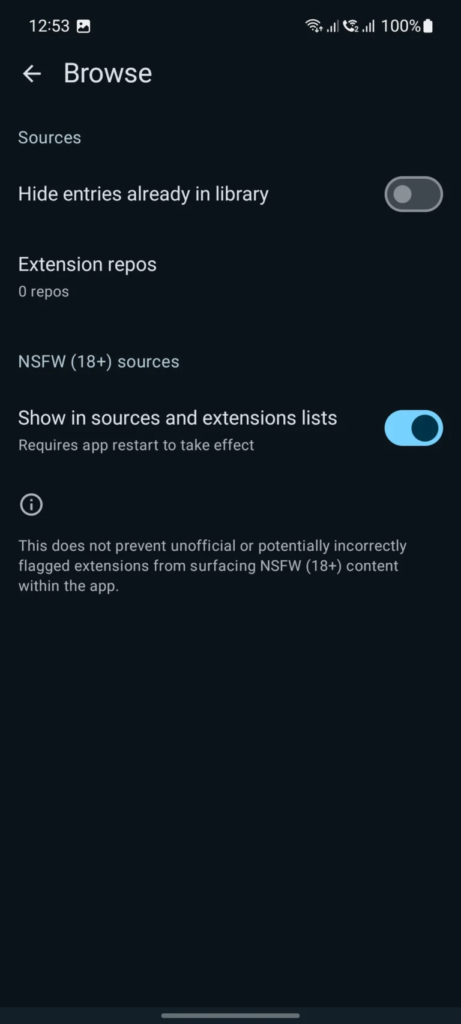
For anyone specifically concerned about content exposure, the Browse settings include a dedicated NSFW (18+) sources toggle that controls whether mature-flagged extensions appear in your sources and extensions lists at all — worth knowing about if you’re setting up the app for a shared or family device. Note that this toggle relies on individual extensions correctly flagging their own content, so it’s a helpful filter rather than an absolute guarantee.
Practical safety checklist: – Only download from an official or well-established, reviewed source. – Confirm file size matches the expected ~20–22 MB range. – Avoid APKs bundled inside unrelated “installer” or “booster” apps. – Keep the app updated to receive the latest security patches. – Be selective about which extensions you install, since extension quality and safety varies by source maintainer.
Pros and Cons of Tachiyomi
Pros: – Completely free with no forced ads in the official build – Massive effective library size through unlimited extensions – Deep customization of themes, layout, and reading modes – Full offline reading support – Privacy-focused, local-first data storage – Reliable backup and restore system – Actively developed by an open-source community – Works across phones, tablets, and PC via emulator
Cons: – Requires manual extension setup — not beginner-instant like a curated app – Larger effective storage footprint once chapters are downloaded – Can be confusing for first-time users navigating Library, Browse, and Settings separately – No official iOS version – Extension reliability depends on third-party source maintainers, not the core app – Slightly steeper learning curve than single-catalog manga apps
Troubleshooting Common Tachiyomi Issues
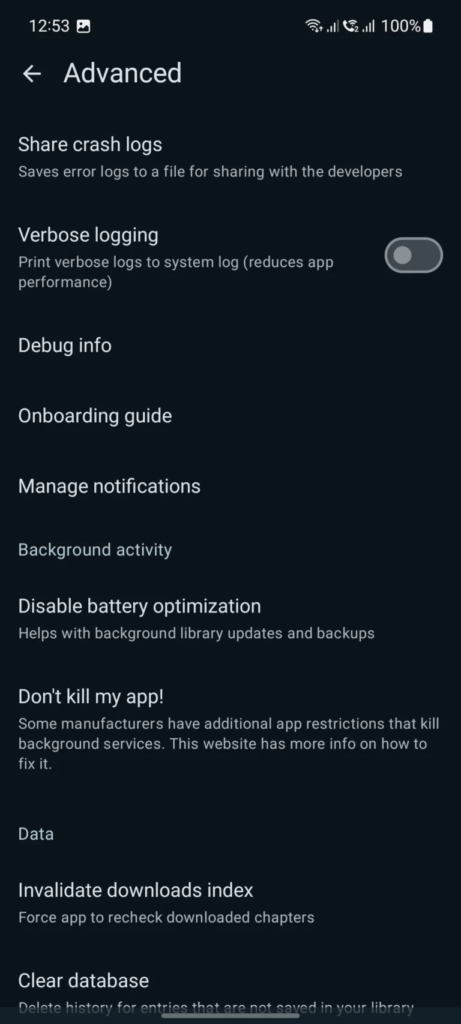
The Advanced settings screen is your best friend when something goes wrong: Share Crash Logs saves error details to a file you can send to developers when reporting a bug, Disable Battery Optimization helps with background library updates and backups on phones that aggressively kill background apps, and Invalidate Downloads Index forces the app to recheck which chapters are actually downloaded if your storage and library get out of sync.
App running slowly or lagging: Clear the app cache from Settings, disable or remove extensions you no longer actively use, and reduce the number of sources being refreshed simultaneously during Library updates.
Extension not working or showing errors: Website layout changes on the source’s end are the most common cause. Check for an extension update in Browse → Extensions, and if the issue persists, the source itself may be temporarily down rather than the app being at fault.
Chapters not downloading: Confirm storage permissions are granted, check available device storage space, and verify your download queue isn’t paused in Settings.
Library not refreshing new chapters: Try a manual swipe-to-refresh on the Library screen, confirm the relevant extension is still installed and updated, and check your internet connection.
Backup restore failing: Ensure you’re restoring a backup created by a compatible app version, and that the backup file wasn’t corrupted during transfer between devices.
For a more exhaustive, issue-by-issue troubleshooting reference, visit our dedicated Tachiyomi troubleshooting guide.
Tachiyomi Old Versions and Version History
While the latest Tachiyomi version is almost always the best choice for security and compatibility, there are legitimate reasons to need an older build — testing on a legacy device, compatibility with an older Android OS version, or reverting after an update introduces an unexpected bug. A complete archive spanning older releases through the current build is available on our Tachiyomi old versions page, along with our old versions category for browsing by release date.
Always verify that any older version you install is sourced from the same trusted origin as the current release, since outdated APKs circulating on random file-sharing sites are far more likely to be tampered with than actively maintained current builds.
Frequently Asked Questions
What is Tachiyomi? Tachiyomi is a free, open-source Android app for reading manga, manhwa, manhua, and light novels through community-built extensions that connect to various online sources.
Is Tachiyomi free to download and use? Yes, Tachiyomi is completely free, with no subscription fees and no ads in the official build.
How do I download the Tachiyomi APK? Download the APK file from a trusted, official source, then follow the installation steps covered earlier in this guide.
What is the latest version of Tachiyomi? The current stable release is regularly updated; check the latest Tachiyomi version page for the most recent build number and changelog.
Is Tachiyomi available on the Google Play Store? No, Tachiyomi is not distributed through the Play Store due to its extension-based content model, so it must be downloaded and sideloaded directly.
Can I download Tachiyomi on iPhone? No, there is no official iOS version. See our Tachiyomi iOS guide for the available workarounds.
Can you use Tachiyomi on a PC? Yes, using an Android emulator such as BlueStacks or NoxPlayer, following our Tachiyomi PC guide.
Can you read light novels on Tachiyomi? Yes, through compatible extensions such as Madara-based or LNMTL-based light novel sources.
Is Tachiyomi safe to use? Yes, when downloaded from a trusted source. It’s open source and requests only the permissions needed for storage, downloads, and notifications.
Is Tachiyomi illegal to use? The app itself is legal; legality of specific content depends on the individual extension/source you choose to install.
Is Tachiyomi still working in 2026? Yes, it remains functional and is regularly maintained, alongside actively developed forks like Mihon.
How does Tachiyomi work? It functions as a reading engine that connects to manga websites through installable extensions, letting you browse, download, and read content from a unified library.
How do I add a new extension in Tachiyomi? Go to Browse → Extensions, search for the source you want, and tap Install.
How do I add manga to my library? Open a source under Browse, find a title, and tap “Add to Library.”
How do I download manga chapters? Open a manga’s detail page, long-press a chapter, and tap the download icon, or select multiple chapters to download in bulk.
How can I make Tachiyomi load faster? Clear the app cache, remove unused extensions, and limit the number of sources refreshing at once.
How do I use Cubari-style sources in Tachiyomi? Add compatible aggregator URLs as a custom source through the app’s WebView or a dedicated extension built for that purpose.
Is Tachiyomi down right now? The core app generally isn’t “down” since it runs locally, though individual extensions/sources can go offline temporarily.
What should I use instead of Tachiyomi? Mihon is the most actively developed continuation; other options include Tachimanga, Komikku, Neko, and Mangazone — see our alternatives comparison.
Can I download Tachiyomi on any Android phone, including budget models? Yes, it runs on any Android 5.0+ device, though performance in webtoon/continuous scroll mode benefits from at least 2GB RAM.
Are all manga sources on Tachiyomi legal? It depends entirely on the specific source/extension; the app itself is content-neutral.
Why is Tachiyomi not working on my device? Usually caused by an outdated extension or a source website that’s temporarily down rather than an issue with the core app.
How do I uninstall old extensions? Long-press the extension in Browse → Extensions and select uninstall.
How do I delete downloaded chapters to free up space? Go to Settings → Downloads → Delete Downloaded Chapters, or long-press individual chapters in your library.
Which app can fully replace Tachiyomi? Mihon is considered the closest direct successor, maintaining the same extension ecosystem and core functionality.
Can I still download Tachiyomi if development has slowed? Yes — older and current builds remain available through trusted archives, and actively developed forks like Mihon continue the same model.
Does Tachiyomi support backup and restore across devices? Yes, full library backups can be created and restored, including categories and reading history, as covered in our backup guide.
What reading modes does Tachiyomi support? Eight total layout options, including Left-to-Right, Right-to-Left, Vertical, Continuous Vertical, Webtoon, Single Page, and Double Page modes.
Does Tachiyomi track reading progress automatically? Yes, your last-read chapter and progress are saved automatically per title, and can sync with external trackers if enabled.
Is there a way to browse all sources at once? Yes, Global Search lets you search every installed extension simultaneously instead of browsing one source at a time.
Final Thoughts
Tachiyomi remains one of the most flexible, privacy-respecting, and genuinely free ways to read manga, manhwa, manhua, and light novels on Android in 2026. Its open-source foundation, extension-based content model, and deep customization options give readers a level of control that closed, ad-driven apps simply can’t match — and with actively maintained forks like Mihon carrying the torch forward, the ecosystem this app started continues to evolve.
Whether you’re downloading the Tachiyomi APK for the first time, setting up extensions, choosing the right reading mode for webtoons versus traditional manga, or troubleshooting an extension that stopped working, everything you need is covered above. Bookmark this guide, grab the latest Tachiyomi version, and start building your library.
For everything else — extension guides, PC and iOS setup, old version archives, and full troubleshooting — explore the complete Tachiyomi resource hub for ongoing updates as new versions and extensions roll out.